Few things test your sanity quite like staring out the window at a sheet of sleet while your brand-new irons sit gathering dust in the garage. For decades, winter meant hitting balls into a ratty net at an unheated municipal range, praying your fingers wouldn't freeze off before you fixed that persistent slice. Today, building the best home golf simulator setup has shifted from an ultra-rich vanity project into something legitimately reachable for everyday gear junkies. But before you clear out the garage and convince yourself that a projector screen will double as an anniversary present, let's take a brutally honest look at whether building a high-tech hitting bay at home actually justifies the cash and hassle.
The Rise of the At-Home Fairway
Golf tech used to require industrial-sized hardware, radar arrays the size of carry-on suitcases, and a bank account that could absorb five-figure invoices without blinking. Over the past five years, optical tracking cameras, miniaturized doppler radar, and budget-friendly graphics engines have completely democratized indoor golf. What used to be exclusive to tour pros and commercial fitting bays now fits on a coffee table. Finding the best home golf simulator no longer means ordering custom construction crews; it means picking the right tracking unit for your specific ball-striking habits and pairing it with smart hardware. Whether you want a dedicated practice tool to shave two strokes off your handicap or a party piece to play Pebble Beach with friends while drinking cold beer in your socks, the market has exploded with viable options at nearly every tier.
Space and Ceiling Height: The Unforgiving Physics
Here is where most dreams die a sudden, painful death: vertical clearance. You might think your eight-foot basement ceilings are plenty tall until you try to rip a 45-inch driver with an upright swing. In reality, nine feet is the absolute bare minimum for comfortable iron play, and ten feet is the magic number where you can unleash a full, aggressive driver swing without the phantom terror of punching a graphite shaft through the drywall. If you are on the taller side or possess an unusually steep backswing, ten and a half feet is even safer.
Width and depth are equally ruthless. You need at least 10 to 12 feet of width to center the ball and swing freely, though offset setups can squeeze into narrower footprints if you don't mind aiming slightly diagonal. For depth, plan on needing roughly 14 to 16 feet: six to eight feet between the ball and the impact screen so the ball can decelerate safely, plus another seven to ten feet behind the ball to accommodate your backswing and whatever radar-based launch monitor you happen to be using. If you have an open garage bay or an unfinished bonus room, you are in luck. If you are eyeing a spare guest bedroom, prepare to sacrifice your driver and stick strictly to wedge play.
Budgeting for Your Setup: From Shoestring to Country Club
The financial barrier to entry spans a massive spectrum. You can piece together a functional, bare-bones garage simulator for around $2,000 to $3,000. That bracket gets you a solid entry-level radar unit (like a Garmin Approach R10 or Rapsodo MLM2PRO), an iPad to run the display, a durable hitting mat, and a basic net that protects your water heater from stray shanked four-irons.
Step up to the sweet spot of $5,000 to $9,000, and you cross into legitimate virtual golf territory. Here, you get high-accuracy photometric launch monitors (like a Bushnell Launch Pro or SkyTrak+), a heavy-duty impact screen, an enclosure that catches errant toe strikes, a gaming PC, and a dedicated 1080p short-throw projector. If you want tour-grade ball and club data alongside 4K visuals—think TrackMan or Foresight GCQuad—you are looking at $15,000 to $30,000 and beyond. Be realistic about what you want to accomplish; the hardware at the $6,000 mark measures 95% of what everyday golfers care about, like launch angle, ball speed, and spin axis.
Essential Gear vs. Nice-to-Haves
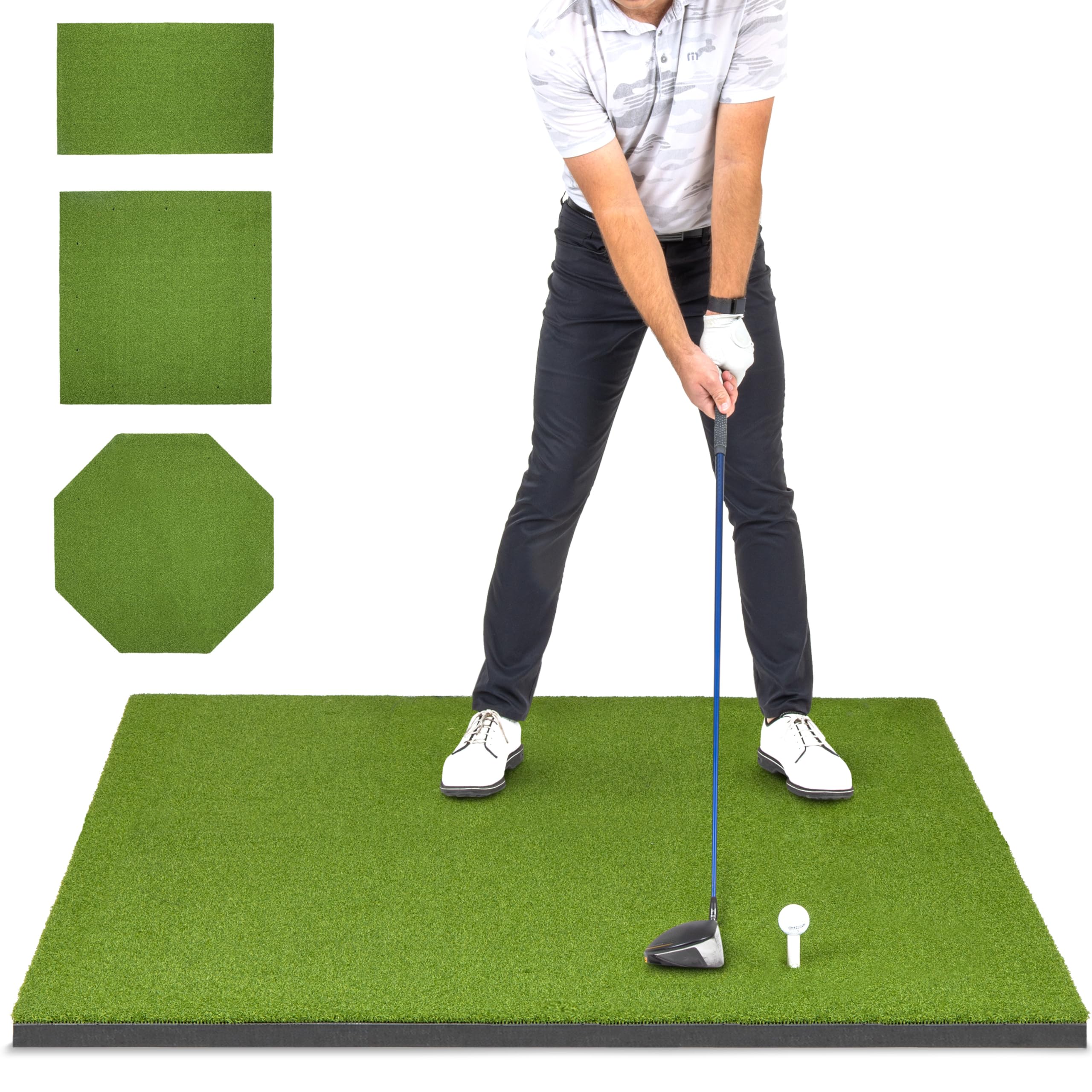
Do not skimp on your hitting mat. Cheap range mats feature a paper-thin layer of green turf glued straight onto hard rubber, which will send shocking vibrations straight into your wrists and lead to chronic golfer's elbow within three weeks of daily practice. Invest in a thick, joint-friendly mat with a deep foam base or gel inserts—brands like Fiberbuilt or Carl's Place exist for a reason. Your elbows and lead hip will thank you.
The impact screen and side netting are non-negotiable safety items. An ordinary bedsheet or cheap canvas drop cloth will tear within a hundred strikes, sending a ball at 140 miles per hour right into your drywall or vehicle windshield. Buy a triple-layer polyester screen designed to absorb high-velocity impacts with minimal bounceback. On the flip side, 4K laser projectors, motorized retractable screens, and custom spotlighting are classic nice-to-haves. A budget 1080p projector running on a mid-tier gaming laptop delivers plenty of immersion without doubling your overall build expenses.
Software and Connectivity: Where the Fun Lives
The launch monitor captures the data, but the software creates the illusion that you are actually standing on the first tee. Platforms like GSPro, TGC 2019, and E6 Connect run the physics simulations and render thousands of community-built and official golf courses. GSPro, in particular, has become the enthusiast favorite because it costs an affordable annual subscription and features a rabid community building hyper-detailed real-world courses.
Make sure you consider the technical plumbing before buying. Optical camera units work great in tight spaces because they sit next to the ball, but they often require tethered USB connections or robust Wi-Fi to send data to your PC without annoying lag. Radar-based units sit behind the golfer and need clear lines of sight, plus special metallic stickers on the ball to read spin accurately indoors. Nothing kills the vibe faster than waiting eight seconds after a swing for the software to finally register where the shot went, so make sure your home network can reach your hitting bay.
DIY vs. Professional Installation
Building your own bay requires intermediate DIY chops: cutting EMT conduit pipes to frame your enclosure, tensioning bungees, mounting projector brackets into ceiling joists, and cable-managing a rat's nest of HDMI runs. If you enjoy spending a weekend in the garage with a socket wrench and a tape measure, going DIY saves you several thousand dollars in labor and gives you intimate knowledge of how to repair worn parts down the road.
Professional installation makes sense when you want a turnkey luxury setup integrated cleanly into finished living spaces. Professional builders bring custom padded walls, seamless turf integration that runs flush with your floors, and dialed-in soundproofing so a midnight driving session doesn't wake the kids upstairs. But for most hobbyists, a pre-measured DIY enclosure kit offers the perfect middle ground between frustrating scratch-built frames and exorbitant contractor fees.
The Final Verdict: Is It Worth It?
If you play golf twice a year in scramble tournaments and spend the rest of your weekends on the couch, building a simulator is an expensive dust magnet. But if you are the type of player who genuinely obsesses over face-to-path ratios, desperately wants to maintain your swing mechanics through the dead of winter, or simply loves the idea of hosting friends on a Friday night without paying $80 an hour at a commercial venue, it is worth every penny. A home simulator fundamentally changes your relationship with the game: ten minutes of spare time transforms from mindless phone scrolling into fifty focused iron shots. Keep your expectations grounded on room dimensions and mat quality, and you will never regret pulling the trigger.